You catch it in photos, on video calls, or under bright bathroom lighting. Something looks slightly off, but not enough to name right away. Then you see it. Your front teeth do not line up exactly with the center of your face. A small dental midline shift can feel bigger the more you notice it, especially when you are already thinking about veneers, whitening, bonding, or orthodontic work at a local dental practice serving Hayward residents.
If that sounds familiar, you are not being overly critical. The center line of the teeth does affect how a smile reads. At the same time, not every shift needs treatment, and not every perfectly centered smile looks more natural. In smile design, the real question is not whether a tiny mismatch exists. The question is whether it is visible, whether it bothers you, and whether fixing it would improve both appearance and function.
Dental midline discrepancy matters when the shift is visible and connected to the rest of the smile
The dental midline is the line between your two upper front teeth, compared with the center of your face. In many people, those lines are not perfectly matched. That is common. A small difference may go unnoticed in normal conversation, while a larger shift can make the smile look tilted or uneven even when the teeth themselves are healthy.
Research on smile esthetics shows that people do not judge every mismatch the same way. Perception changes based on the amount of shift, the direction, the lip line, tooth shape, and whether there are other concerns nearby, such as crowding or canting. A review on smile esthetics and facial midline relationships explains that small deviations are often tolerated more easily than patients expect, especially by people who are not trained in dentistry. You can read more in this review of dental and facial midline esthetics.
That is where stress tends to build. You may be looking at one detail in isolation, while your dentist is looking at the full picture. If your teeth are healthy, your bite is stable, and the shift is minor, treatment may offer very little benefit. If the shift comes with wear, bite problems, asymmetry, or planned cosmetic work, it becomes more relevant.
Smile design decisions depend on visibility, bite function, and your goals
A small midline shift can happen for many reasons. Natural tooth position, crowding, missing teeth, jaw differences, past dental work, or habits that changed the bite can all play a part. Sometimes the upper dental midline is off. Sometimes the lower is off. Sometimes the face itself is not perfectly symmetrical, which changes how the smile is perceived.
This is why a quick mirror check rarely gives a full answer. You might think, “If the line is off, it should be fixed.” That sounds simple, but treatment has to match the cause. If the issue comes from mild crowding, clear aligners may help. If it is tied to old restorations or uneven tooth edges, bonding or veneers might improve the look without major movement. If the shift is tiny and your smile is balanced, the best plan may be no treatment at all.
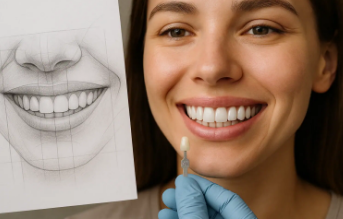
Current literature on digital smile planning also supports a more tailored approach. Clinicians use facial references, tooth proportions, lip movement, and patient preferences together, not just one center line. This article on digital smile design and esthetic analysis reflects how modern planning weighs symmetry against natural appearance and function.
That nuance matters financially too. Chasing perfect symmetry can lead to more treatment than you need. Orthodontics, cosmetic bonding, contouring, or restorative changes all have costs, time demands, and maintenance. If the result will be barely visible to anyone but you, it is fair to ask whether the investment matches the payoff.
A small shifted smile line does not always need correction
People often assume cosmetic dentistry aims for mathematical perfection. Good smile design does not work that way. A smile can be attractive, healthy, and natural with a slight off center dental midline. In fact, over-correcting one feature can make the whole smile feel less real if tooth shape, gum display, and lip support are ignored.
The better standard is harmony. Does your smile look balanced when you talk and laugh? Does your bite feel comfortable? Are you focused on one tiny detail because you truly dislike it, or because you have stared at close up photos too long? Those are different situations, and they lead to different decisions.
| Situation | Treatment may not be needed | Treatment may be worth considering |
| Midline shift size | Very small and hard to notice in normal conversation | Clear shift visible in photos, speech, or full smile |
| Bite and function | No pain, no uneven wear, stable bite | Crowding, shifting bite, wear, or jaw strain |
| Cosmetic impact | Smile still looks balanced overall | Smile appears tilted or asymmetrical |
| Planned dental work | No major cosmetic changes planned | Veneers, bonding, crowns, or aligners already under consideration |
| Patient concern | You rarely notice it and it does not affect confidence | You notice it often and it changes how you smile |
There is also growing support for using facially guided planning rather than relying on one rigid landmark. This recent review on smile design principles shows how esthetic decisions are strongest when they combine facial analysis, tooth display, proportions, and patient expectations.
Practical steps help you decide whether cosmetic or general dentist treatment makes sense
Take normal, not extreme, photos. Use a few relaxed photos taken at arm’s length, plus one short video of yourself talking. Close up mirror checks can exaggerate tiny asymmetries. A natural smile in motion gives a more honest picture of whether the shift is actually visible.
Ask for a cause based diagnosis. If you see a general and cosmetic dentist, ask what is creating the shift. Is it tooth position, old dental work, gum asymmetry, or your bite? Ask what happens if you leave it alone, and what the least invasive option would be if you want improvement.
Compare outcomes, not just procedures. If aligners, bonding, or veneers are discussed, ask to see what each option changes and what it does not. The best plan for dental midline correction is the one that improves your smile without creating extra work, cost, or maintenance you did not want.
A small midline shift is not automatically a problem. Sometimes it is part of a natural, balanced smile. Sometimes it is the detail that keeps the whole smile from feeling right to you. Both reactions are valid. What matters is getting a careful evaluation that looks at your face, your bite, and your goals together, then choosing treatment only if the benefit is clear.
If you are weighing changes to your smile, schedule a consultation with a general and cosmetic dentist and ask for a full smile design assessment before making any decision.