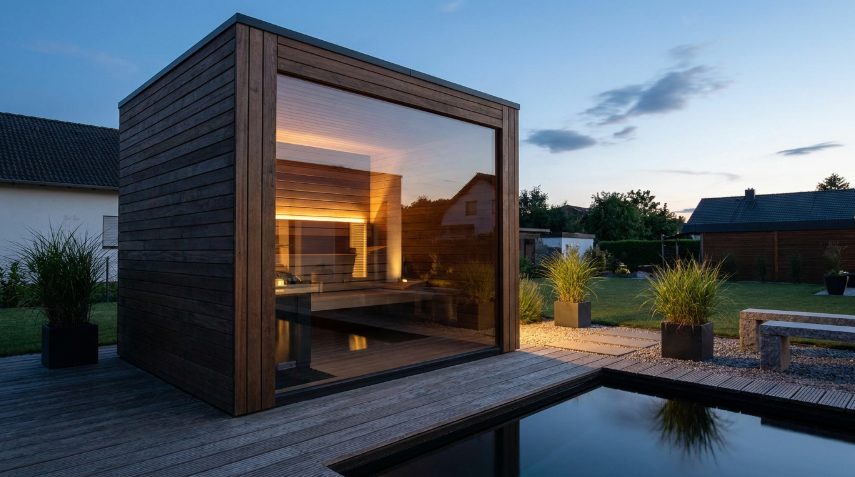
Cedar offers built-in natural rot and insect resistance along with a recognizable aroma, usually at a higher price point, while heat-treated hemlock reaches comparable moisture resistance through thermal processing at a lower cost, without the same scent. Both hold up well inside a properly ventilated cube sauna. The right pick depends less on which wood is objectively superior and more on which use case fits: budget, climate, and whether the classic cedar smell matters to the people using the sauna.
What Makes Cedar the Traditional Choice?
Western red cedar has been the default sauna wood for decades because its natural oils resist rot and insects without any additional treatment step. It also releases a mild, recognizable scent when heated, which many longtime sauna users associate with the experience itself. Cedar tends to be lighter in weight than denser hardwoods and stays relatively cool to the touch even at high cabin temperatures. The tradeoff is cost: cedar generally carries a higher price per board foot than hemlock, and that premium shows up directly in the total price of a cedar-built cube sauna compared to one built from a thermally treated alternative species.
What Is Heat-Treated Hemlock, and How Is It Different?
Heat-treated hemlock starts as a less expensive base species that does not have cedar’s natural rot resistance on its own. The thermal modification process, which involves heating the wood to high temperatures in a low-oxygen environment, changes its cell structure in a way that reduces its ability to absorb moisture and makes it more dimensionally stable under repeated heat cycling. The result is a wood that performs close to cedar for sauna-specific purposes, warping resistance and moisture tolerance, at a noticeably lower material cost. It does not carry cedar’s characteristic aroma, which some buyers see as a plus if they find heated cedar scent too strong.
Best Use Case: Humid or Coastal Climates
In consistently humid or coastal environments, moisture resistance matters more than almost any other wood property, since the exterior faces near-constant dampness on top of the interior humidity generated during sessions. Both cedar and heat-treated hemlock perform well here, and the deciding factor often comes down to budget rather than a meaningful performance gap. Buyers in these climates should prioritize whichever option their budget allows in a properly ventilated design over stretching for a specific species if it means cutting corners elsewhere, like undersized roof venting.
Best Use Case: Budget-Conscious First-Time Buyers
For a first cube sauna where cost is the primary constraint, heat-treated hemlock is usually the more practical starting point. It delivers the moisture resistance and stability that actually matter for sauna longevity without paying the species premium cedar commands. A first-time buyer unsure whether they will use a sauna often enough to justify a premium build is generally better served putting the savings toward a properly sized heater and correct electrical work, both of which affect the experience more directly than wood species choice.
Best Use Case: Buyers Who Want Zero Resin Scent
Some buyers, particularly those sensitive to strong wood aromas or who plan to use the sauna for long sessions, prefer a more neutral scent profile. Heat-treated hemlock, along with thermo-treated spruce, tends to have a milder smell than cedar once heated, since the thermal processing reduces the volatile compounds responsible for a strong aroma. This is a purely preference-based use case rather than a performance one; cedar’s scent is not a defect, but for buyers who find it overpowering, a thermally treated alternative solves the problem directly.
Best Use Case: DIY Builders Sourcing Lumber Locally
Builders assembling or modifying a sauna themselves, rather than buying a complete factory kit, often make wood choice decisions based on regional lumber availability. Cedar is widely available in the Pacific Northwest and parts of the South, while hemlock is more commonly sourced in the Northeast and parts of Canada, and heat-treated versions of either are increasingly available through specialty suppliers rather than standard lumber yards. A DIY builder’s real-world choice frequently comes down to which thermally treated species a regional supplier actually stocks, more than an abstract preference between the two.
How Factory Cube Sauna Kits Usually Decide This For You
Most factory-built cube sauna kits settle the cedar-versus-hemlock question by using a different, but related, thermally treated species instead of either one. Thermo-treated spruce, for example, goes through a similar thermal modification process to heat-treated hemlock, reducing moisture absorption and improving dimensional stability, but starts from a different source tree with its own grain pattern and density. Buyers who want to compare a factory thermo-treated spruce build against a cedar or hemlock DIY approach can look at the SweatDecks the SaunaLife CL7G collection to see how a manufacturer-specified thermal wood build is priced and specified compared to sourcing cedar or hemlock independently for a custom project.
Best Use Case: Buyers Who Care About Visual Match With Existing Decking
Cedar’s warm reddish-brown tone is a common match for existing cedar decking or fencing, which matters to buyers who want the sauna to look like it belongs with the rest of the yard rather than standing out as an obviously different material. Heat-treated hemlock, along with thermo-treated spruce, tends to take on a deeper, more uniform amber-brown color from the thermal process itself, which reads as more distinctly modern next to natural, untreated wood. Neither look is better on its own merits; it comes down to whether the goal is blending in with existing outdoor structures or having the sauna read as its own architectural feature.
Best Use Case: Buyers Prioritizing Consistent Grain and Fewer Knots
Knots in sauna wood are not just cosmetic. A knot is a weak point where the grain direction changes abruptly, and under repeated heat and moisture cycling it can eventually loosen or crack before the surrounding clear wood does. Cedar boards, particularly higher grades, are often selected for minimal knots, while heat-treated hemlock and thermo-treated spruce used in factory kits are frequently specified as knotless for bench material specifically, since benches take the most direct, sustained contact. Buyers who want the most consistent surface underfoot and against the back should ask specifically about knot grade rather than assuming species alone determines it.
Which Wood Actually Lasts Longer?
Under proper ventilation and basic maintenance, cedar, heat-treated hemlock, and thermo-treated spruce all commonly reach fifteen to twenty five years of service life in a cube sauna application. The wood species matters less to longevity than installation quality and maintenance habits: a cedar sauna with poor drainage at the base will fail sooner than a well-drained heat-treated hemlock build. Species choice is a real factor in cost, scent, and sourcing, but it is not the dominant variable in how long the structure ultimately lasts.
Frequently Asked Questions
Is cedar or heat-treated hemlock better for a cube sauna? Neither is universally better. The choice depends on budget, climate, and whether scent matters to the buyer.
Does heat-treated hemlock perform as well as cedar in a sauna? Yes, reasonably well, for dimensional stability and moisture resistance under repeated heat cycling.
Why does cedar cost more than heat-treated hemlock? Cedar’s natural rot resistance is built in without extra processing, which has historically supported a price premium.
Is thermo-treated spruce the same as heat-treated hemlock? No, different species that go through a similar thermal modification process with slightly different grain and density.
References
- Cardiovascular and Other Health Benefits of Sauna Bathing: A Review of the Evidence, Mayo Clinic Proceedings, 2018
- Does the Combination of Finnish Sauna Bathing and Other Lifestyle Factors Confer Additional Health Benefits? A Review of the Evidence, Mayo Clinic Proceedings, 2023
- Effects of heat and cold on health, with special reference to Finnish sauna bathing, American Journal of Physiology, 2018
By Lauren Kowalski